
Mental Health & The Menstrual Cycle: Connecting FAM + Mental Wellness
Often overlooked but vital, the menstrual cycle speaks volumes about your health. In recent years,

For many people, parenthood is treated as an inevitability, something that will happen if you want it badly enough, plan carefully enough, or simply wait your turn. Yet for a growing number of individuals and couples, the desire for children exists alongside life circumstances that make parenthood feel perpetually out of reach.
This experience is often referred to as circumstantial childlessness.
Circumstantial childlessness describes a deeply human reality: wanting children, being emotionally and sometimes physically capable of parenthood, yet finding that timing, access, partnership, health, or systemic barriers repeatedly stand in the way.
What makes circumstantial childlessness particularly challenging is that it often lives in a gray zone. There may be no clear diagnosis, no definitive “no,” and no obvious timeline, only ongoing uncertainty. And while it is not always recognized as such, circumstantial childlessness can carry a profound mental and emotional burden.
In this article, we’ll explore what circumstantial childlessness is, how it differs from infertility, the mental health concerns that commonly accompany it, and how integrative fertility counseling can provide grounded, whole-person support for those navigating this experience.

Circumstantial childlessness refers to a situation in which an individual or couple desires children but is unable to pursue or achieve parenthood due to external or contextual factors, rather than a confirmed diagnosis of infertility.
Importantly, circumstantial childlessness is not about “waiting too long” or “not trying hard enough.” It reflects the intersection of relational, social, economic, biological, and systemic realities, many of which are shaped by forces far beyond individual control.
Circumstantial childlessness can arise from a wide range of situations, including:
Over the past several decades, the timeline for marriage and parenthood has shifted significantly. In the United States, the median age of first marriage and first birth has steadily increased. Many women pursue higher education, career development, financial stability, or personal healing before actively planning for children. At the same time, partnership formation itself has become less predictable.
An increasingly common experience among women in their 30s is not ambivalence about motherhood, but difficulty finding a partner who feels equally ready for commitment, marriage, or parenthood. While men, on average, are also marrying later than previous generations, readiness within relationships does not always align. Some women describe spending critical reproductive years in partnerships marked by hesitation, delayed timelines, or differing levels of desire for children.
In this context, delayed childbearing is not always a matter of postponement by choice.
It often reflects the complex interplay between evolving gender roles, economic pressures, dating culture, and the biological reality that female fertility remains time-sensitive. When relational timing and biological timing fall out of sync, the result can feel less like a personal decision and more like a narrowing window shaped by circumstance.
While delayed parenthood does not inherently lead to childlessness, it can create a painful intersection between lived relational realities and age-related fertility changes.
Clinically and personally, circumstantial childlessness often shows up as:
Because there is no single moment where the door fully closes, many people remain suspended in a prolonged state of uncertainty.
This ambiguity can be emotionally exhausting. It is a form of ambiguous loss, grieving something that has not definitively ended, yet has not materialized either.
While the experiences can overlap, circumstantial childlessness is distinct from infertility.
Both experiences deserve care, validation, and support. Neither is “less real” or “less painful” than the other.

Circumstantial childlessness is associated with a range of psychological and emotional challenges, many of which go unrecognized or unsupported.
Common mental health concerns include:
Because circumstantial childlessness does not always come with a medical label, many individuals feel they lack permission to grieve. They may be told to “stay positive,” “be patient,” or “focus on what you do have.” While often well-intentioned, these responses can deepen isolation and silence.
Circumstantial childlessness can quietly reshape relationships:
Over time, these relational and internal shifts can compound, making support feel even more necessary and yet harder to seek.

Integrative fertility counseling is a whole-person, trauma-informed approach to reproductive mental wellness. It recognizes that fertility experiences are not just biological events, but deeply emotional, relational, and embodied ones.
Rather than focusing solely on outcomes or timelines, integrative fertility counseling centers regulation, meaning-making, and agency, especially when certainty is limited or absent.
Support may include:
For many people experiencing circumstantial childlessness, integrative fertility counseling offers:
Support does not erase uncertainty. But it can make uncertainty more survivable.
Finding the right integrative fertility counselor can be a key part of managing circumstantial childlessness. It’s important to choose a counselor who is knowledgeable, compassionate, and can support you in the specific areas you need.
As an integrative, functional fertility counselor, I support individuals navigating circumstantial childlessness through both professional training and lived experience.
My work integrates functional nutrition and hormone health, fertility awareness education, integrative mental health therapy, fertility counseling, hypnotherapy, and yoga therapy. I approach this work with nuance, trauma-awareness, and deep respect for the complexity of reproductive journeys.
Having personally navigated circumstantial childlessness, I understand how isolating and disorienting it can feel, especially when there are no clear answers. My goal is not to rush you toward a specific outcome, but to help you feel resourced, supported, and grounded wherever you are in the process.
If you are seeking thoughtful, integrative support, I invite you to reach out.
Looking for the right counselor is essential to help you manage the emotional effects of circumstantial childlessness. Once you find a counselor who aligns with your needs, you can begin to work towards healing and finding peace.
Circumstantial childlessness occurs when external, relational, or systemic circumstances prevent someone from moving forward with parenthood, even when the desire is present. It is not simply about delay, indecision, or lack of effort. It often reflects a complex convergence of partnership dynamics, shifting social timelines, economic realities, and biological limits.
The emotional impact can be significant, touching identity, relationships, self-worth, and one’s sense of future.
While this experience can feel isolating, it does not have to be navigated alone. Integrative fertility counseling offers a holistic, compassionate approach that honors both the biological and emotional dimensions of reproductive life. With appropriate support, it is possible to move forward with greater clarity, resilience, and self-trust, regardless of how the path ultimately unfolds.
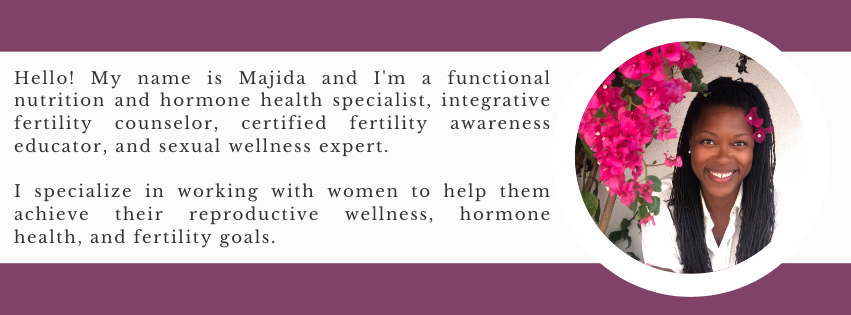
If you’re looking for a holistic, personalized approach to your fertility journey, I’m here to help. I’m Majida, and at Connection Care Therapy, I offer integrative fertility counseling that combines my formal training with specialized expertise to support your whole self.
With a Master’s in Mental Health Counseling with a focus in Fertility Counseling, Reproductive Trauma, and Integrative Approaches to Reproductive Health, plus certifications as a fertility awareness educator and functional nutrition & hormone health specialist, I bring comprehensive, evidence-based support to your fertility journey.
My integrative approach includes:
Whether you’re trying to conceive naturally, undergoing assisted reproductive technology, optimizing your hormone health, or processing challenges and loss, I can create a tailored program to meet your needs.
You don’t have to navigate this journey alone. Let’s work together to support your fertility, your health, and your wellbeing.
Ready to take the next step?
Contact Connection Care Therapy today to schedule a consultation and begin your path toward greater understanding, agency, and hope.
Disclaimer:
The information provided on this blog is for educational and informational purposes only and is not intended as a substitute for professional medical advice, diagnosis, or treatment. Always seek the advice of your physician or other qualified health provider with any questions you may have regarding a medical condition. The content on this blog is not meant to replace professional medical advice or to be used to prevent, diagnose, or treat any disease or illness. Reliance on any information provided by this blog is solely at your own risk.
Often overlooked but vital, the menstrual cycle speaks volumes about your health. In recent years,

In today’s world, more women are seeking natural and safe methods to enhance their understanding

Exploring the connection between fertility awareness and birth control can seem overwhelming given the myriad
You’ve probably heard of environmental toxins. Whether it’s concerns raised over what is sprayed on

Do you notice shifts in energy levels, moods, and cravings throughout your menstrual cycle? Many

If you’re looking to enhance your reproductive health or gain a better understanding of fertility